AI translated content will get almost instantly deindexed off Google
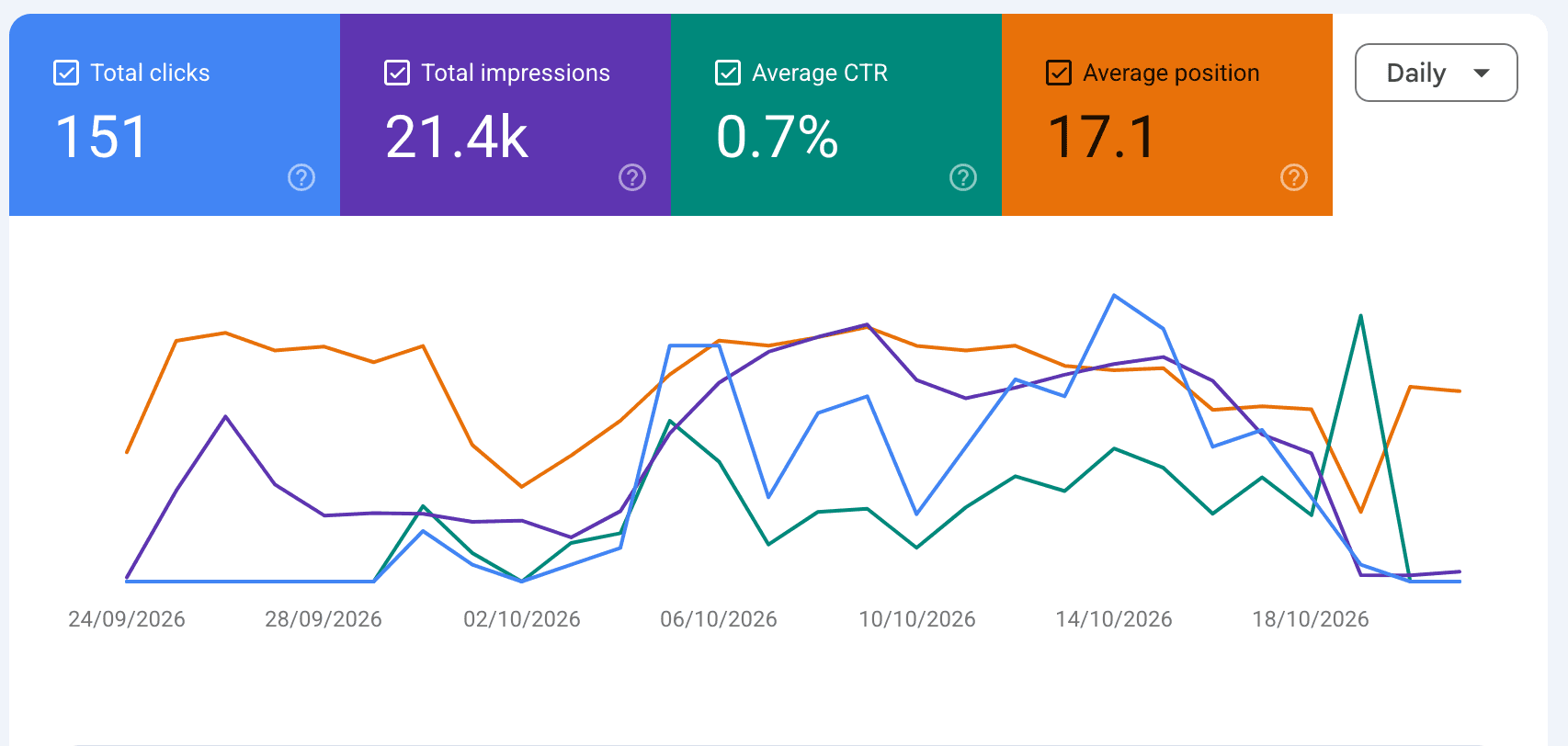
AI translated content, deindexed in weeks: I machine translated each country's calculator into its native language, 73 languages in all, got 150 clicks in under two weeks, then dropped to zero.
 Ryan Anderson4 min read
The experiment
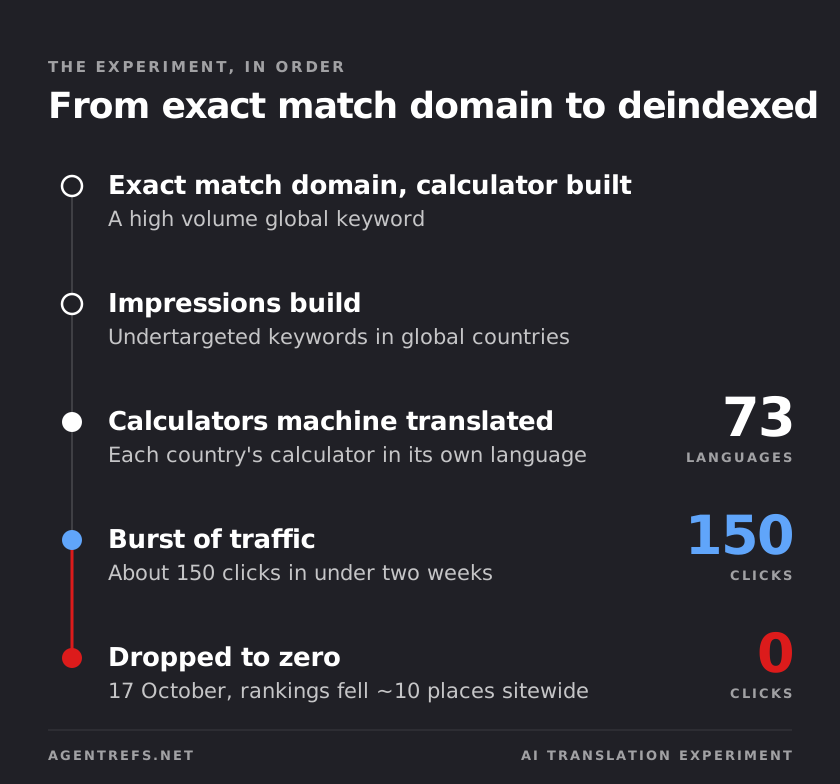
The experiment: bought an exact match domain in a high volume global keyword, built a calculator around it, and AI translated it into 73 languages.
Initially impressions were promising with a high volume of keywords due to a few specific undervalued/undertargeted keywords for global countries that clearly were not being competed for.
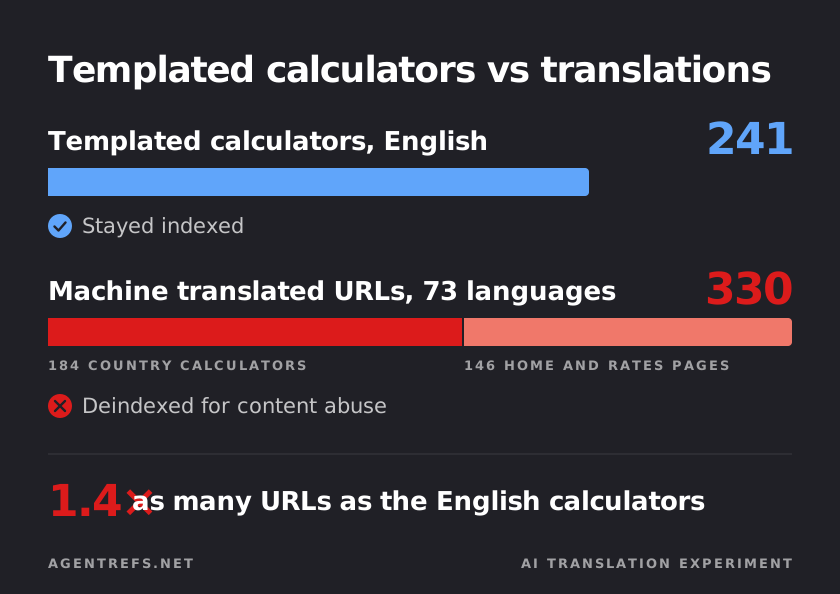
I then translated each country’s calculator into its native language, 73 languages and 330 translated URLs in all, and immediately got a burst of traffic, about 150 clicks in under two weeks. All translations were correctly pointing to each other too so as to not compete for keywords between the same pages.
The drop to zero
October 17th traffic suddenly dropped to zero as rankings fell around 10 points across the board, suggesting that Google has marked the site as low quality. Specifically for ‘scaled content’ abuse. The worst part is that it affected the ENTIRE site, not just the translated pages or the newly ranked pages. Everything including the home page crashed overnight. I went from position #11 on the EMD to position #22 overnight.
What I am going to do about it
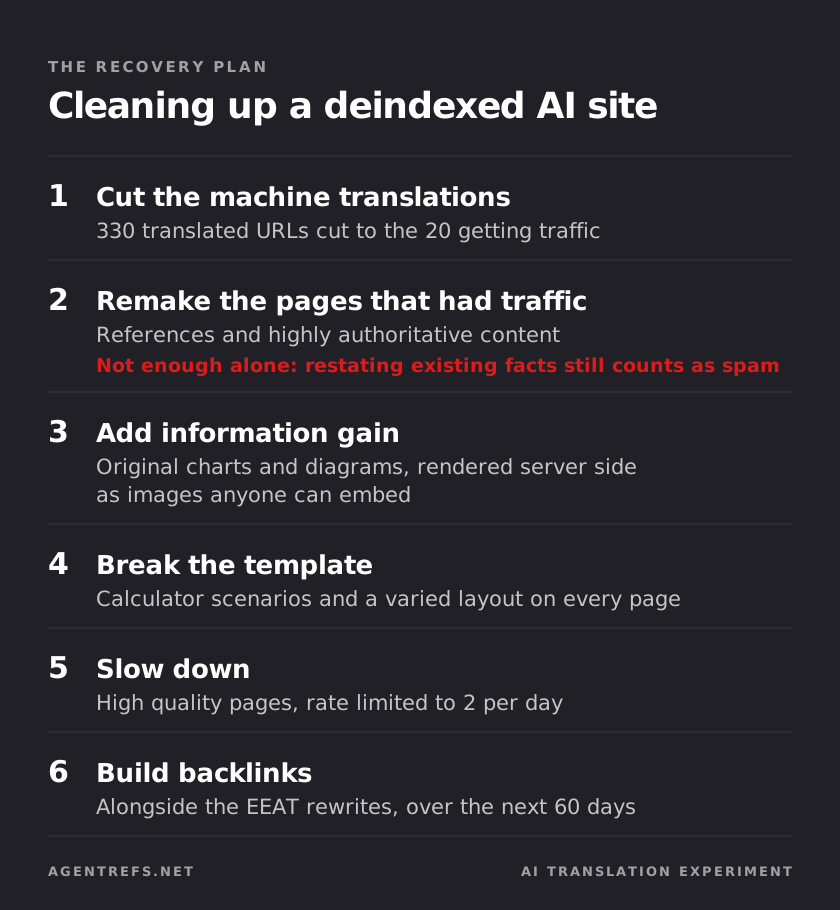
I now have data on underserved niches globally in this specific calculator niche. I have already removed all the pages that contained machine translations bar the specific ones that were getting traffic. All the ones that were getting traffic have now been remade to contain references and highly authoritative content.
This alone is not enough because as of Google’s latest update simply restating existing facts is still considered content abuse and spam. Hence we need to add something new to the situation.
In order to be creating new information I had Opus draw a bunch of high quality charts and diagrams and render them server side so they appear as PNGs anyone can embed onto their site. This introduces natural information gain to the site as the diagrams are new, never before seen images, which naturally counts as new information in Google’s indexer.
This alone is not likely to be enough, so I also had Opus create several scenarios for the calculator to be applied and introduced variation to each page’s layout so that layout detection is less likely to be triggered (there’s a great article on X about how AI content can be detected not just by the word order but by the actual content structure!).
What I learned
Overall so far this has been an interesting experiment but a bit of a waste of resources. I spent an equivalent of a $100 Max plan doing the site generation to produce 241 templated calculators (218 countries and 23 keyword pages) and that didn’t seem to trigger content abuse, however machine translating it did. I suppose machine translations are seen as a low quality attempt to game the system? Likely this means for SEO purposes doing a single page translation per day might be the limit.
I think that this was not the only likely cause here, at the same time that the crash happened Google started cracking down on mass generated content even harder than usual and all of my pages were actually not conforming to EEAT and did not have much new or verifiable data or links out. The key to test this will be if backlinks and EEAT written pages over the next 60 days will be enough to rectify the domain getting burnt or if this is a one and done kind of situation.
The next experiment
The next experiment will be to take this page and attempt to rank it again even after the impressions and clicks went straight to zero. I do suspect that cleaning the site up and focusing on high quality pages with a rate limit of 2 per day might help it to re-rank, but at the same time it may be burnt for a long time.
I am glad I did this experiment because I was about to launch another site using a similar methodology, but it seems like I will have to change my plan and go back to the original method of a single page per day or so on the highest value keywords with a re-write of the best pages.
Final thoughts
I think this is one of the hard things about SEO, it’s very easy to ‘give in’ to the dark side and just take the advice on X at face value and apply it. The only thing I would say is that most SEOs have something to sell you (myself included), so you should really only trust the actual tests they run, not the random ‘here’s how to rank your pages’ content that they put out.

See what ChatGPT says about you today
Send your site and one question your buyers ask. We run it through the five assistants and send the audit back within 1 business day.
Ryan reads every request.
Rather email? [email protected]